 English
 Indian
 العربية
 Español
 Deutsch
 Türkçe
 Русский
 Français (Afrique)

According to the latest data in early 2026, Cristiano Ronaldo leads the official all‑time goal‑scoring charts, with 819 goals counted by IFFHS and 862 by PFSA. Lionel Messi follows closely behind, while historic figures such as Josef Bican and Pelé remain in the conversation because different counting methods produce varying totals.
The Ever‑Shifting Debate Over the Greatest Scorer
Talk about soccer and the question of who sits at the very top of the goal‑scoring pantheon and you will instantly hear a chorus of voices. Some fans cling to the romance of the past, pointing to legends whose names were shouted from packed stadiums before television ever existed. Others argue that the modern game, with its higher tempo and more games per season, gives current stars a statistical edge. Statisticians add another layer by debating which competitions should count, while the media constantly churns out fresh numbers as active players add to their tallies.
In 2026 the conversation feels especially lively because two very different sources released fresh data that adds new layers to the story. The International Federation of Football History and Statistics (IFFHS) published a monthly ranking that showed French forward Kylian Mbappé as the leading scorer for January, thanks to four goals in the Champions League. At the same time the Professional Football Scouting Association (PFSA) updated its “Top 15 Goalscorers in Football History” list, reminding everyone that the all‑time leaderboard is dominated by a handful of legends whose numbers still dwarf those of most modern players.
What makes the all‑time rankings so fascinating is the way they blend raw numbers with context. A goal scored in a World Cup final carries a different weight in the public imagination than one netted in a lower‑division league match, yet most official tallies treat every strike equally as long as it occurs in a recognized competition. The result is a never‑ending debate that feels as much about storytelling as it is about statistics.
How Different Organizations Count Goals
The IFFHS methodology counts goals scored for national teams in full internationals and for clubs in the main stages of major continental tournaments, but it excludes qualifying rounds. That means a player who scores heavily in the early phases of a Champions League campaign may see those goals left out of the official total. The PFSA, on the other hand, embraces a broader career total that includes domestic league, cup and continental fixtures. Their approach also adds goals from some regional competitions that the IFFHS treats as secondary.
Both approaches have merit. The IFFHS method offers a clean, comparable set of data that focuses on the highest‑profile matches, while the PFSA’s inclusive tally paints a richer picture of a player’s overall contribution across all fronts. When the two lists are placed side by side, patterns emerge that help explain why certain names dominate the conversation.
Below is a simple table that lines up the most frequently cited figures from both organizations. The numbers reflect the most recent updates available in early 2026.
| Player | IFFHS Official Total | PFSA Inclusive Total | Primary Era |
|---|---|---|---|
| Cristiano Ronaldo | 819 | 862 | 2000s‑2020s |
| Lionel Messi | 805 | 848 | 2000s‑2020s |
| Pelé | 767 | 777 | 1950s‑1970s |
| Ferenc Puskás | 746 | 754 | 1940s‑1960s |
| Gerd Müller | 735 | 743 | 1960s‑1970s |
| Josef Bican | 805* | 822* | 1930s‑1950s |
| Romário | 772 | 785 | 1990s‑2000s |
*Bican’s exact total varies depending on which regional matches are counted; both organizations acknowledge the uncertainty.
The table shows that even when the counting rules differ, a core group of players remains at the summit. Their goal totals range from the high‑six hundreds to well over eight hundred, a margin that separates them from the rest of the sport’s great marksmen.
Historical Giants of the Scoring Charts
The earliest names on any all‑time list belong to players whose careers unfolded before television turned soccer into a global spectacle. Ferenc Puskás, the Hungarian forward who dazzled the world in the 1950s, is credited with 746 official goals. His record includes a staggering 84 strikes for the national team and a prolific spell at Real Madrid where his precision from the edge of the box became legendary.
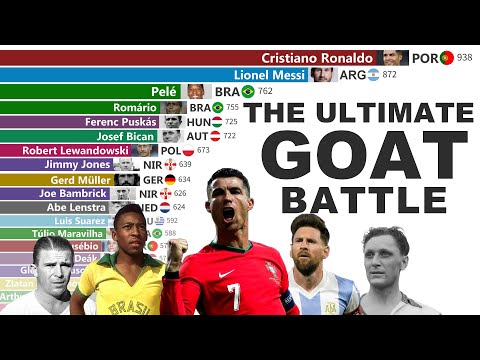
Josef Bican, an Austrian‑Czech striker, is often cited as the all‑time leader with a claimed 805 goals, though some historians argue that the exact figure varies depending on which matches are counted. Bican’s career spanned the turbulent years before, during and after World War II, and his ability to find the net in both Central European leagues and the early European Cup earned him a reputation that still echoes today.
A goal’s value is shaped as much by story as by statistics.
Different tally rules keep the debate about the greatest scorer alive.
Pelé, the Brazilian icon, finished his career with 767 goals according to the most widely accepted statistics. He scored the majority of those in Brazil’s domestic competitions, but his three World Cup triumphs and a handful of goals in the North American Soccer League cement his status as a global phenomenon. Romário, another Brazilian legend, claimed to have reached the 1,000‑goal mark when unofficial friendlies and youth games are added, but official tallies place him just shy of 800.
Gerd Müller, the German “Der Bomber,” amassed 735 goals in official matches, most of them for Bayern Munich and the West German national team. His relentless poaching in the penalty area made him a nightmare for defenders in the 1970s. Each of these giants built their legacies in eras where record‑keeping was less standardized, which is why different sources sometimes report slightly different numbers.

What ties them together is not just the sheer volume of goals but the cultural impact each had. A Puskás goal in the 1954 World Cup final still sparks debate about the greatest strike ever seen. A Pelé header in the 1970 World Cup final is replayed in documentaries as a symbol of Brazilian flair. Their achievements set the benchmark that modern players chase.

The Modern Contenders and Their Latest Numbers
Fast forward to the present day and the conversation shifts to a new generation of athletes who are rewriting the record books with the aid of advanced training, nutrition and a calendar that offers more matches than ever before. Cristiano Ronaldo and Lionel Messi dominate the modern discussion, each hovering around the eight‑hundred‑goal mark in official tallies.
- IFFHS excludes qualifying rounds while PFSA includes them.
- Ronaldo’s official totals are 819 (IFFHS) and 862 (PFSA).
- Messi’s totals are 805 (IFFHS) and 848 (PFSA).
- Bican’s exact figure varies, noted as 805 by IFFHS and 822 by PFSA.
- Puskás, Müller and Romário each have totals in the mid‑700s to high‑700s range.
- Goal weight in public memory differs between World Cup finals and lower‑division matches.
- The all‑time leaderboard is dominated by a core group of eight players.
Ronaldo’s journey began in the Portuguese leagues before he exploded onto the scene at Manchester United, then moved to Real Madrid, Juventus and now back in the Saudi Professional League. His blend of aerial power, clinical finishing and relentless work ethic has allowed him to add goals at a steady pace even as he moves into his late thirties. The PFSA’s latest update shows him edging past Messi by a narrow margin that has fluctuated over the past few seasons, a testament to the fierce competition between the two.
Messi’s story is equally compelling. Rising through the ranks at Barcelona, he spent two decades turning the Camp Nou into a personal gallery of dribbles, free‑kick wonders and tap‑in finishes. After a surprising move to Paris Saint‑Germain and then a stint in the United States, Messi continues to add to his tally with a style that relies on vision and precision rather than sheer physicality.
- Ronaldo holds the current lead in both major goal‑counting lists.
- Messi remains a close challenger with only a few dozen goals behind.
- Historical giants like Pelé, Puskás and Bican still rank among the top ten.
- Counting methods differ: IFFHS focuses on elite matches, PFSA includes all official fixtures.
- Variations in older records create ongoing debate about exact totals.
Beyond the duopoly, younger talents are beginning to make their mark. Kylian Mbappé, now in his mid‑twenties, has already surpassed the 300‑goal threshold in official competitions and is adding to that total with each Champions League appearance. Erling Haaland, the Norwegian striker known for his explosive pace and powerful shot, is on a trajectory that could see him breach the 400‑goal mark within the next few seasons if he stays injury‑free.

The modern era also brings new statistical tools that track every touch, shot and expected‑goals metric. While traditional goal totals remain the headline, analysts now look at conversion rates, shot locations and the quality of opposition to add nuance to the conversation. This deeper analysis helps explain why a goal in a high‑pressure knockout match may be valued more by fans even if the official tally treats it the same as a goal in a routine league fixture.
FAQ
- How do IFFHS and PFSA count goals differently?
- IFFHS counts goals scored in full internationals and the main stages of major continental tournaments, but it leaves out qualifying matches. PFSA includes domestic league, cup, continental and some regional competitions, giving a broader picture of a player’s total.
- Which player is currently at the top of the all‑time scoring list?
- Cristiano Ronaldo sits at the summit with the highest totals in both IFFHS (819) and PFSA (862) rankings, edging out Lionel Messi by a small margin.
- Why do older players sometimes have uncertain goal totals?
- Record‑keeping in earlier eras was less standardized, so matches from regional leagues or wartime competitions may be counted by some sources and ignored by others, leading to variations in figures for players like Josef Bican.
- Do World Cup goals count more than league goals?
- Statistically every goal in a recognized competition counts the same, but goals in high‑profile events such as World Cup finals carry extra weight in public perception and storytelling.
- Can modern players surpass the historic legends?
- With more games per season and longer careers, active stars have the statistical opportunity to exceed the totals of past greats, which is why the debate stays lively each year.
Why Accurate Data Matters – Lessons From Other Fields
The endless debate over goal‑scoring records highlights a broader truth: reliable data is the foundation of any meaningful discussion. In fields far removed from sport, the consequences of inaccurate information can be severe. For example, a recent study of legal filings revealed more than 1,100 documented court cases that involved AI‑fabricated legal citations. Attorneys and pro se litigants alike submitted references to cases that simply did not exist, and the number continues to rise.
That situation underscores the importance of verification. In soccer, the same principle applies. When organizations like the IFFHS and PFSA publish their numbers, they must be transparent about the criteria they use and the sources they rely on. Fans, journalists and historians all benefit when the data can be cross‑checked against match reports, federation archives and reputable databases.
The legal world’s experience with AI‑generated misinformation serves as a cautionary tale for sports statisticians. Just as a lawyer must verify every citation before filing a brief, a soccer analyst should confirm each goal’s legitimacy before adding it to a player’s total. This practice protects the integrity of the sport and ensures that the legends of the past are honored accurately, while the achievements of current stars are celebrated on a solid factual base.
In the end, the conversation about who leads the all‑time rankings is more than a numbers game. It is a reflection of how we remember greatness, how we compare eras, and how we trust the information that shapes our collective memory. Whether you side with the IFFHS’s stricter counting method, the PFSA’s inclusive approach, or a hybrid of both, the key is to keep the dialogue open, grounded in verified data, and respectful of the players who have given us countless moments of joy on the pitch.